
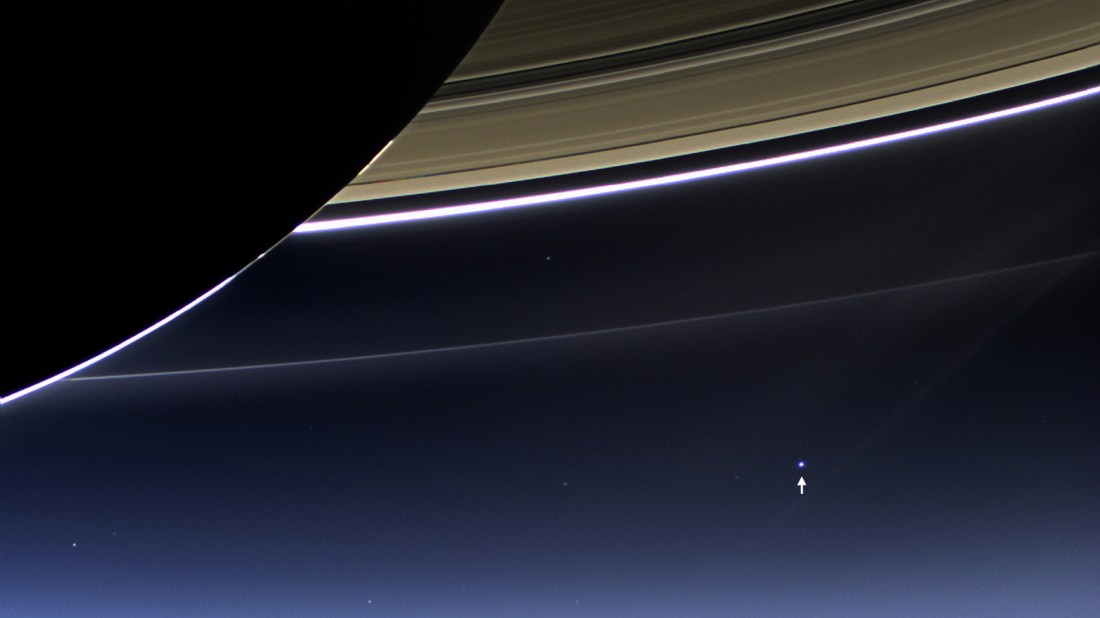
The other day on the web I saw a picture of the earth as it appears from Saturn. From that perspective, it is a barely discernable little luminescent pin prick. It struck me also, that that picture was taken from a neighborhood that in cosmic terms is so close as to be virtually abutting ours. The
But let me move on to a thought experiment. If the sun were the size of a basketball, the nearest star to us, Proxima Centauri, would be the equivalent of five thousand miles away. To speak of greater distances, like the distance across the Milky Way galaxy, which is, by the way, roughly 100,000 light years across, is not really to speak of any distance we can understand at all. True, we have a way to manipulate it, but its actual magnitude is out of our ken. We can go on to consider that there are billions of galaxies spread across the universe, but we are not really “considering” anything at all, since we are not capable of comprehending much beyond what it would mean to drive somewhere in a day or two.
Time presents much the same problem as distance. To say that the earth is four and a half billion or so years old is also really sort of meaningless with reference to human experience. I have found most helpful the graphic illustrations. If a football field is to represent the age of the earth, then each yard would represent 46 million years. That distance, in itself, is truly unfathomable, in that representation the whole of human history would be less than the thickness of a blade of grass at the end of the field. (http://faculty.weber.edu/bdattilo/default.html) John McPhee, uses the term “deep time” , another metaphor, to help in the understanding of the scale in which we operate.
My goal here is not to belabor the obvious but to ask what implications can be drawn. The problem is that the context in which we find ourselves does “Tease us out of thought, as does eternity” as Keats put it. A more elaborated version of the human experience can be found in “The Doubloon” in Moby Dick, a book which is at pains to point how how random are the ways we try make worlds we can think about. In the passage, the major characters examine the doubloon which Ahab has nailed to the mast and each, for this physical artifact supplies his own meaning—one that it doesn’t intrinsically have any more than the planet Saturn has one. Ahab knows the problem. As he observes, elsewhere in the book,
“Oh! time was, when as the sunrise nobly spurred me, so the sunset soothed. No more. This lovely light, it lights not me; all loveliness is anguish to me, since I can ne’er enjoy. Gifted with the high perception, I lack the low, enjoying power; damned, most subtly and most malignantly! damned in the midst of Paradise!.” (165)
But he also recognizes that as long as he is going to have to supply a reason for action, he might as well make it ultimately solipsistic and invest the whole world with one of his own devise. Doing so is his way of reacting to his irrelevance.
To put things in perspective, it turns out that there are really only two stories. The rest are all variations on a theme, and may, from one perspective, be equally irrelevant. Every story involves, fundamentally, a character’s inability to reconcile some notion of his sense of self-worth with a world that is fundamentally absurd and yet, for which, therefore, most people have supplied a structure.
This is not at all a novel notion. It is the fundamental premise of existential literature, but more on that later. The issue is this—every one must think that his actions have value, but there is nothing in the great scheme of things to suggest that they do. Even mathematical “values”, if we wish to call them that, are abstractions—the things we apply them to have no notion of their application—they have an absolute indifference
The fact is, of course, that we are left with no option but to act. That’s why Hamlet, after observing to Rosencrantz and Guildenstern that “there is nothing good or bad but that thinking makes it so, “ finds himself compelled to move on. He finds “justice”, or something like it a reason to act. He settles on a moral reason, though it cannot stand up intellectually as anything ultimately efficacious. Strangely, Hamlet sort of begins where Macbeth, whose famous soliloquy follows, leaves off:
To-morrow, and to-morrow, and to-morrow,
Creeps in this petty pace from day to day,
To the last syllable of recorded time;
And all our yesterdays have lighted fools
The way to dusty death. Out, out, brief candle!
Life’s but a walking shadow, a poor player,
That struts and frets his hour upon the stage,
And then is heard no more. It is a tale
Told by an idiot, full of sound and fury,
Signifying nothing.
Macbeth also finds a reason to go on, namely his dignity or pride.
Melville’s “Bartleby The Scrivener”’s eponymous character is one of the very few in my reading who actually remain true their conceptions and gradually “prefer” not to do anything at all, even to eat. The struggle of the narrator to deal with the fundamental truth that Bartleby represents is the real point of the story. Thus, I think, the ending: “Ah Bartleby, ah humanity.”
The real sin, of course, is in believing that the orientation we bring to the world is the TRUE one. This fault has been the source of the greatest evils of mankind, and remains fundamentally indefensible for anyone who reflects honestly on his “place”, for lack of a better word, in the universe. And the greatest crime, as Socrates pointed out, is to adopt a set of values only because someone else—a minister, a parent, the state, etc. has told us not to reflect, but only to believe. As he remarked, “The unexamined life is not worth living.”
Thus we end—either refusing to question the values we use to define ourselves, or using some values which we know we are using in bad faith. The ancients could naively find meaning in the stars, but it’s hard for us to look at them honestly.
 MrKelly'sNeighborhood